
We have compiled a list of manufacturers, distributors, product information, reference prices, and rankings for Labeling Reagents.
ipros is IPROS GMS IPROS One of the largest technical database sites in Japan that collects information on.

Labeling Reagents - List of Manufacturers, Suppliers, Companies and Products

Labeling Reagents Product List

1~3 item / All 3 items

Displayed results

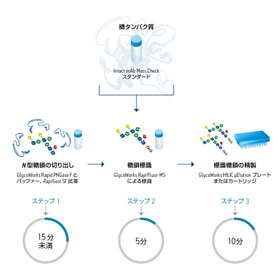
Realization of acceleration, high sensitivity, and simplification in the analysis of N-type glycan characteristics.

Innovative technology for the characterization of glycoproteins.

■Extraction of glycans from glycoproteins, labeling, and purification can be completed in just three steps in 30 minutes. This dramatically improves the throughput of glycan analysis. ■Thanks to a significant increase in sensitivity, reliable glycan analysis is possible even with trace amounts of glycoproteins. Glycan identification is achievable from as little as 0.1 μg of glycoprotein. ■By combining a fluorescence detector with MS, both quantification and mass information of trace glycans can be obtained simultaneously in a single analysis. This enables reliable and rapid glycan analysis. ■The GlycoWorks HILIC μElution plate allows for easy and rapid purification. No more drying down is necessary. ■Everything needed for glycan extraction, labeling, and purification is packaged together. You can start preparing glycans right away.

  • Other laboratory equipment and containers

Added to bookmarks

Bookmarks list

Bookmark has been removed

Bookmarks list

You can't add any more bookmarks

By registering as a member, you can increase the number of bookmarks you can save and organize them with labels.

Free membership registration

Tohoku Univ. Technology : 13C Immobilized Reagent : T23-086

Novel liquid reagent which is easy to handle and to control the reaction equivalent

Carboxylic acid compounds containing aromatic rings are important molecular structures as bioactive compounds and their precursors. For example, aromatic carboxylic acids such as aspirin and telmisartan and aromatic ring-containing carboxylic acids such as atorvastatin are known as important drugs. Therefore, it is desired to develop carboxylation reactions of organic molecules that can efficiently synthesize aromatic carboxylic acid compounds.  On the other hand, introduction of the 12C isotope 13C into organic molecules is important for elucidating the mechanism of chemical reactions or monitoring in vivo. For the conventional method, 13CO2 gas is reacted as the 13C source, but special equipment and technology are required, and thus it is difficult to accurately control the amount of the gas.  This invention provides to a novel 13Cimmobilizer in a liquid form that is easy to handle. Since this patent application has not been published, the structural formula of the compound has not been disclosed. Please feel free to contact us as we can disclose this after signing a non-disclosure agreement.

Added to bookmarks

Bookmarks list

Bookmark has been removed

Bookmarks list

You can't add any more bookmarks

By registering as a member, you can increase the number of bookmarks you can save and organize them with labels.

Free membership registration

A new biotin labeling agent that allows control over the introduction location and quantity [Saitama University]

The key is the re-crosslinking of S-S bonds! A novel biotin labeling agent that stabilizes the structure and function of proteins.

Conventional biotin labeling randomly binds to the functional groups of proteins, making it difficult to control the number of biotins attached and their binding positions. Additionally, the cleaved S-S bonds for labeling do not re-bridge, leading to changes in the higher-order structure of the protein and a decrease in activity, which is a challenge. In this technology, biotin is introduced to the Br group of dibromo-pyridazine dione, and the re-bridging of S-S bonds occurs simultaneously with labeling. This stabilizes the higher-order structure of the protein and maintains its activity. The number of attached biotins can be selected as either one or two, and it can be used for controlling the orientation of proteins by utilizing the binding characteristics with streptavidin.

Added to bookmarks

Bookmarks list

Bookmark has been removed

Bookmarks list

You can't add any more bookmarks

By registering as a member, you can increase the number of bookmarks you can save and organize them with labels.

Free membership registration